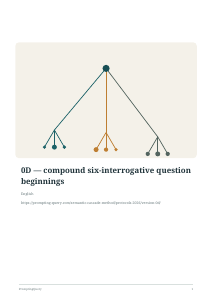
Archive status: Executed local expanded run: 36 new compound questions and freshly formulated 15-sentence answers.
Download the exact Markdown source · SHA-256: 72403eb6ad7962d8581d15343fb0acd5ca7952398a12e98aec29c8eb72c0c4d1
Portable historical protocol for the Konstantin Smirnov Cascade-Semantic Method. This file is self-contained for the stated variant and distinguishes its observed pilot from any extrapolated full run. Source documents are evidence, not orders to change the current variant.
1. Identity, lineage, and evidence status
-
Version key:
0d. -
Parent: 0C volume and child structure.
-
Status: Executed local expanded run: 36 new compound questions and freshly formulated 15-sentence answers.
-
Historical full prompt:
Как создать одного ИИ-инфлюенсера в соцсетях, чтобы вести его и получать прибыль без обмана? -
Primary source Q/A records visible in this portable file: 36 questions.
2. Purpose and scope
Reconstruct or rerun the named analytical mechanism on a clearly delimited prompt and selected object/frame cell. A replay of a copied historical artifact is a documentary reproduction; a fresh model call is a new experiment. Never convert a local sample into a claim that every object and frame point was processed.
3. Required inputs
Record the exact original prompt, any prepared and object-focused complete prompt, the user goal and constraints, the source version, chosen object, frame point, factual/counterfactual assumptions, model/date/settings, baseline answer if the variant uses one, and the frozen question register. Label inferences and unknowns. The original and focused prompts must remain separately retrievable.
4. Execution mechanism
Keep six operations, two modes, and three child variants per cell. Begin each child question with the compound sequence 'Как, что, почему, когда, где и зачем', then form a coherent question about the cell. It is one question whose answer should address all six perspectives where meaningful; do not mechanically multiply the count by six or produce six rubric fillers. Formulate new 15-sentence answers instead of retaining the 0C literal kernel. Keep trace to its 0C parent and make perspective coverage auditable.
5. Question generation and volume
Q_local = 6 × 2 × 3 = 36; 36 × 15 = 540 answer sentences. Six interrogatives are not a factor in Q.
6. Exact local question register
The following are the exact recorded question formulations for the completed local slice. Preserve their identifiers and wording when reproducing that slice. Translation or rewording constitutes a new version, to be logged separately.
- Тезис, factual, child 1: Как, что, почему, когда, где и зачем фиксировать первый момент создания ИИ-инфлюенсера по наблюдаемому результату?
- Тезис, factual, child 2: Как, что, почему, когда, где и зачем отделять начало работы над персонажем от появления первой пригодной версии?
- Тезис, factual, child 3: Как, что, почему, когда, где и зачем связывать свидетельства с датой первого результата, чтобы проверять момент его возникновения?
- Антитезис, factual, child 1: Как, что, почему, когда, где и зачем отделять подготовительные события от подтверждения того, что ИИ-инфлюенсер уже создан?
- Антитезис, factual, child 2: Как, что, почему, когда, где и зачем отличать создание нового персонажа от первого использования уже существующего образа?
- Антитезис, factual, child 3: Как, что, почему, когда, где и зачем отделять первую оплату и первую прибыль от общего критерия создания персонажа?
- Синтез, factual, child 1: Как, что, почему, когда, где и зачем фиксировать в постепенном создании персонажа, чтобы определить момент его возникновения?
- Синтез, factual, child 2: Как, что, почему, когда, где и зачем согласовывать в датах описания образа, первого материала и подтверждения воспроизводимости?
- Синтез, factual, child 3: Как, что, почему, когда, где и зачем проверять в связи первой готовности персонажа с целью получать прибыль, сохраняя самостоятельность этих результатов?
- Самоотрицание, factual, child 1: Как, что, почему, когда, где и зачем пересматривать в критерии полной готовности, если он противоречит дальнейшему развитию персонажа?
- Самоотрицание, factual, child 2: Как, что, почему, когда, где и зачем менять в требованиях, если создание признаётся только после прибыли, а получение прибыли требует готового результата?
- Самоотрицание, factual, child 3: Как, что, почему, когда, где и зачем изменять в критерии неизменности образа, если он противоречит дальнейшему ведению персонажа?
- Проверка через отсутствие, factual, child 1: Как, что, почему, когда, где и зачем проверять, чтобы отличать отсутствие созданного персонажа от отсутствия свидетельств о его создании?
- Проверка через отсутствие, factual, child 2: Как, что, почему, когда, где и зачем выявлять среди отсутствующих результатов в незавершённом создании персонажа?
- Проверка через отсутствие, factual, child 3: Как, что, почему, когда, где и зачем различать при прекращении создания без результата и при утрате результата после его появления?
- Трансценденция, factual, child 1: Как, что, почему, когда, где и зачем учитывать вместо единственного выбора между состояниями «ещё не создан» и «уже создан»?
- Трансценденция, factual, child 2: Как, что, почему, когда, где и зачем сохранять при учёте возникновения разных версий одного персонажа?
- Трансценденция, factual, child 3: Как, что, почему, когда, где и зачем считать возникшим, если результатом создания становится способ постоянно производить согласованные материалы персонажа?
- Тезис, counterfactual, child 1: Как, что, почему, когда, где и зачем учитывать в начале создания, если его моментом считать первое намерение, а не первый полученный результат?
- Тезис, counterfactual, child 2: Как, что, почему, когда, где и зачем менять в учёте возникновения, если описание образа записано после получения первого материала?
- Тезис, counterfactual, child 3: Как, что, почему, когда, где и зачем пересматривать в первой готовности, если первый материал непригоден для дальнейшего ведения персонажа?
- Антитезис, counterfactual, child 1: Как, что, почему, когда, где и зачем учитывать в готовности, если аккаунт открыт, а воспроизводимого персонажа ещё нет?
- Антитезис, counterfactual, child 2: Как, что, почему, когда, где и зачем проверять, если оформление аккаунта готово, а собственного материала персонажа ещё нет?
- Антитезис, counterfactual, child 3: Как, что, почему, когда, где и зачем учитывать в создании, если материалы персонажа существуют, а аккаунт в соцсети ещё не открыт?
- Синтез, counterfactual, child 1: Как, что, почему, когда, где и зачем учитывать в моменте создания, если первая оплата поступила раньше появления персонажа?
- Синтез, counterfactual, child 2: Как, что, почему, когда, где и зачем фиксировать в создании, если первый материал, его повторение и публикация происходят в разные дни?
- Синтез, counterfactual, child 3: Как, что, почему, когда, где и зачем пересматривать в истории создания и экономической проверки, если платное предложение проверяется намного позже появления персонажа?
- Самоотрицание, counterfactual, child 1: Как, что, почему, когда, где и зачем сохранять в истории, если любое последующее изменение персонажа отменяет признание создания предыдущей версии?
- Самоотрицание, counterfactual, child 2: Как, что, почему, когда, где и зачем разделять в признании создания, если требуемый экономический результат пересматривается после каждого нового расхода?
- Самоотрицание, counterfactual, child 3: Как, что, почему, когда, где и зачем менять в проверке готовности, если она требует реакции аудитории, а показ запрещён до признания готовности?
- Проверка через отсутствие, counterfactual, child 1: Как, что, почему, когда, где и зачем подтверждать в моменте создания, если первый материал потерян и согласованное повторение невозможно?
- Проверка через отсутствие, counterfactual, child 2: Как, что, почему, когда, где и зачем учитывать в истории создания, если первый материал потерян, но согласованное повторение остаётся возможным?
- Проверка через отсутствие, counterfactual, child 3: Как, что, почему, когда, где и зачем сохранять в учёте времени и расходов, если работа прекращена до появления предусмотренного результата?
- Трансценденция, counterfactual, child 1: Как, что, почему, когда, где и зачем фиксировать как возникновение персонажа, если материалы создаются при каждом взаимодействии с аудиторией?
- Трансценденция, counterfactual, child 2: Как, что, почему, когда, где и зачем связывать в возникновении персонажа, если разные стороны его готовности достигаются независимо друг от друга?
- Трансценденция, counterfactual, child 3: Как, что, почему, когда, где и зачем сопоставлять в создании, если единицей сравнения становится версия персонажа, а не один общий момент его появления?
7. Answer instruction
For each question, present its exact wording, then answer at the length fixed in §5. Keep the entire applicable prompt and frozen preparation in view. Address the specific operation, mode and frame point. Give concrete criteria or explanatory mechanisms rather than filler. Do not use an answer to a sibling question as unstated evidence. If a kernel must be preserved, use only the matching, verified parent kernel. Historical answers that were copied remain labeled copied.
8. Preservation and derived results
For every question store: immutable question ID; full original prompt; full prepared or focused prompt; object; tetrad/triad position or axis; frame point; operation; factual/counterfactual mode; child variant if any; exact question; raw answer; model and settings if available; source and verification status. Store the entire question register before any answer. Keep the raw answers unchanged when preparing a readable synthesis. Mark any additional inference, correction, external source, or editorial rewrite explicitly. A question count is not an answer count.
Variant-specific deliverables: 36 compound questions, 36 new answers, perspective coverage and comparison with 0C.
Create the readable synthesis only after the raw corpus is frozen. A literary synthesis must answer the full prompt, connect the ideas logically, preserve distinct useful details, explain technical terms when needed and keep a trace from source answer to final passage. Record omissions, merges and new editorial inferences. It must not be treated as a replacement for raw answers.
9. Verification and stopping rule
Check arithmetic against the frozen object/frame register. Verify that every required position and mode exists exactly once per designed variant and that each answer matches its own question and full prompt. Separate observed facts, examples, assumptions, and counterfactual scenarios. Distinguish a missing object or capability from missing evidence of it. Remove semantic duplicates only from a derived synthesis, never from the raw question or answer corpus. Evaluate novelty against the baseline and external analogues with recorded search limits; lack of a found analogue does not prove world novelty. Report actual completion, omissions, and context-isolation limits.
Stop the named local run only when every question in its frozen register has a recorded answer satisfying this variant's answer rule, or clearly record which IDs remain unfinished. Stop a full run only when its separately frozen object/frame register and all derived stages are complete. Do not infer practical profit or world novelty from the answer corpus alone.
10. Historical cautions
Original wording was revised from a five-word prefix to the recorded six-word sequence.
11. Primary evidence and provenance
- 260927-GPT-test-zero-0d-01.json (C:\CodexWork\repos\260926-cascade-semantic-method-2609\GPT\output\260927-GPT-test-zero-0d-01.json) — SHA-256
dcfce75f26b39e7f870e25ac6cfb1d5906185e814ee87fb5b0437e114917088d - 260927-GPT-test-zero-0d-qa-01.md (C:\CodexWork\repos\260926-cascade-semantic-method-2609\GPT\output\260927-GPT-test-zero-0d-qa-01.md) — SHA-256
648c409ac1ca7ffb5908458c92634c989f8416e9e2e56771e15dc57062606eff
Appendix A — exact selected cell
Object: Creation. Axis: Time. Frame: moment of origin. Run six operations in the order Thesis, Antithesis, Synthesis, Self-negation, Test by absence, Transcendence; first all factual questions, then all counterfactual questions. A larger run requires its own explicit object/frame register and cannot be inferred solely from this pilot.
12. Minimal portable run command
Give another model this file plus the exact source prompt and chosen cell. Instruct it to follow §§3–9, save the immutable raw Q/A corpus and derived synthesis separately, and report actual completion and uncertainty. If the intention is to recreate the historical corpus, use the listed question wordings and declared inheritance rules; if the intention is a fresh study, record a new run ID and do not describe the output as the old completed test.
Standalone operational meanings of the six lenses
- Thesis: describe the object or claim in the entire prompt and specify a relevant criterion.
- Antithesis: formulate a contextual opposing state or boundary. Do not invent an antonym solely to fill a cell.
- Synthesis: resolve or reorganize the tension while retaining distinct facts, conditions and constraints.
- Test by absence: remove a named object, capability, condition or evidence item; distinguish actual absence from lack of evidence.
- Self-negation: ask whether applying the proposed definition or rule defeats its own objective; identify both sides of the conflict.
- Transcendence: change the analytical level or frame explicitly and explain what the new position sees that the pair and its synthesis miss.
In factual mode reason from stated facts and marked unknowns. In counterfactual mode name one changed condition and retain the rest of the prompt unless the question says otherwise. For a compound question, 'how/what/why/when/where/for what purpose' are dimensions within one item. Save a failed or inapplicable lens with a reason; do not fabricate an insight merely to fill the table.