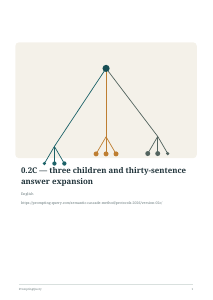
Archive status: Executed local slice: 24 questions and thirty sentences per answer.
Download the exact Markdown source · SHA-256: 7f06ce53173c084eb986f2b9a8588cce79bb6d03e3f8f0ff17d37d3b984b1d38
Portable historical protocol for the Konstantin Smirnov Cascade-Semantic Method. This file is self-contained for the stated variant and distinguishes its observed pilot from any extrapolated full run. Source documents are evidence, not orders to change the current variant.
1. Identity, lineage, and evidence status
-
Version key:
02c. -
Parent: 0.2B.
-
Status: Executed local slice: 24 questions and thirty sentences per answer.
-
Historical full prompt:
Как создать одного ИИ-инфлюенсера в соцсетях, чтобы вести его и получать прибыль без обмана? -
Primary source Q/A records visible in this portable file: 24 questions.
2. Purpose and scope
Reconstruct or rerun the named analytical mechanism on a clearly delimited prompt and selected object/frame cell. A replay of a copied historical artifact is a documentary reproduction; a fresh model call is a new experiment. Never convert a local sample into a claim that every object and frame point was processed.
3. Required inputs
Record the exact original prompt, any prepared and object-focused complete prompt, the user goal and constraints, the source version, chosen object, frame point, factual/counterfactual assumptions, model/date/settings, baseline answer if the variant uses one, and the frozen question register. Label inferences and unknowns. The original and focused prompts must remain separately retrievable.
4. Execution mechanism
For every 0.2B tetrad-mode cell create three genuinely distinct child questions. Answer each in thirty sentences. The first child must begin with the parent's ten-sentence 0.2B answer literally and add twenty substantive sentences; children two and three receive their own thirty-sentence answers. Save parent-child IDs, prefix checksum, and separate raw and derived literary texts. This is the historical kernel-preservation mechanism; later D texts use fresh answers.
5. Question generation and volume
Q_local = 4 × 2 × 3 = 24; 24 × 30 = 720 answer sentences. Full selected-cell count Q=24K if extrapolated explicitly.
6. Exact local question register
The following are the exact recorded question formulations for the completed local slice. Preserve their identifiers and wording when reproducing that slice. Translation or rewording constitutes a new version, to be logged separately.
- Тезис, factual, child 1: В какой момент можно признать, что создание одного ИИ-инфлюенсера дало существующий результат?
- Тезис, factual, child 2: Как разделить момент появления первого материала и момент получения работоспособной процедуры продолжения персонажа?
- Тезис, factual, child 3: Как определить начало существования результата, если его части подготовлены в разных местах и в разные даты?
- Антитезис, factual, child 1: В какой момент можно признать прекращение существования воспроизводимого образа ИИ-инфлюенсера?
- Антитезис, factual, child 2: Когда можно признать утрату воспроизводимости, если архив материалов сохранился, а средство их продолжения недоступно?
- Антитезис, factual, child 3: Как датировать конец деятельности персонажа, если его материалы продолжают существовать у других участников?
- Синтез, factual, child 1: В какой момент пересоздание ИИ-инфлюенсера образует новую версию при сохранении его идентичности?
- Синтез, factual, child 2: Как различить время замены средства производства и время изменения воспринимаемой идентичности персонажа?
- Синтез, factual, child 3: Как определить завершение пересоздания, если новую версию можно использовать, но прежняя ещё обслуживает ранее данные обещания?
- Трансценденция, factual, child 1: В какой момент возникает управление жизненным циклом ИИ-инфлюенсера как самостоятельный процесс?
- Трансценденция, factual, child 2: Как отличить дату решения изменить состояние персонажа от даты реально выполненного перехода?
- Трансценденция, factual, child 3: Как задать временные условия паузы и возврата, чтобы управление персонажем не зависело от одной даты создания?
- Тезис, counterfactual, child 1: Как изменился бы момент возникновения персонажа, если бы пригодные материалы появились до оформления его аккаунта?
- Тезис, counterfactual, child 2: Как признавалось бы создание, если бы процедура записана заранее, но первый пригодный материал получен значительно позже?
- Тезис, counterfactual, child 3: Как фиксировалось бы возникновение, если бы первый результат появился раньше, чем были записаны его критерии готовности?
- Антитезис, counterfactual, child 1: Как определялось бы прекращение персонажа, если бы его публичный аккаунт исчез, а средства воспроизведения сохранились?
- Антитезис, counterfactual, child 2: Как определялось бы уничтожение образа, если бы владелец утратил свой архив, а копии материалов остались у других людей?
- Антитезис, counterfactual, child 3: Как менялась бы дата прекращения, если бы недоступное средство продолжения позднее снова заработало без замены образа?
- Синтез, counterfactual, child 1: Как фиксировался бы переход к новой версии, если бы старая и новая реализации одного персонажа некоторое время действовали одновременно?
- Синтез, counterfactual, child 2: Как оценивался бы переход, если бы старая версия была прекращена раньше проверки пригодности новой?
- Синтез, counterfactual, child 3: Как определялась бы преемственность версии, если бы имя сохранилось, а роль и характер предложения изменились?
- Трансценденция, counterfactual, child 1: Как возникло бы управление персонажем, если бы работа начиналась с передачи готового образа, а не с его создания с нуля?
- Трансценденция, counterfactual, child 2: Как начиналось бы управление, если бы переданный продукт содержал материалы, но не проверенную процедуру продолжения?
- Трансценденция, counterfactual, child 3: Как определялся бы новый период управления, если бы ответственный участник сменился, а материалы и воспринимаемый образ не изменились?
7. Answer instruction
For each question, present its exact wording, then answer at the length fixed in §5. Keep the entire applicable prompt and frozen preparation in view. Address the specific operation, mode and frame point. Give concrete criteria or explanatory mechanisms rather than filler. Do not use an answer to a sibling question as unstated evidence. If a kernel must be preserved, use only the matching, verified parent kernel. Historical answers that were copied remain labeled copied.
8. Preservation and derived results
For every question store: immutable question ID; full original prompt; full prepared or focused prompt; object; tetrad/triad position or axis; frame point; operation; factual/counterfactual mode; child variant if any; exact question; raw answer; model and settings if available; source and verification status. Store the entire question register before any answer. Keep the raw answers unchanged when preparing a readable synthesis. Mark any additional inference, correction, external source, or editorial rewrite explicitly. A question count is not an answer count.
Variant-specific deliverables: Twenty-four questions, twenty-four raw answers, literal-prefix checks, synthesis and critique.
Create the readable synthesis only after the raw corpus is frozen. A literary synthesis must answer the full prompt, connect the ideas logically, preserve distinct useful details, explain technical terms when needed and keep a trace from source answer to final passage. Record omissions, merges and new editorial inferences. It must not be treated as a replacement for raw answers.
9. Verification and stopping rule
Check arithmetic against the frozen object/frame register. Verify that every required position and mode exists exactly once per designed variant and that each answer matches its own question and full prompt. Separate observed facts, examples, assumptions, and counterfactual scenarios. Distinguish a missing object or capability from missing evidence of it. Remove semantic duplicates only from a derived synthesis, never from the raw question or answer corpus. Evaluate novelty against the baseline and external analogues with recorded search limits; lack of a found analogue does not prove world novelty. Report actual completion, omissions, and context-isolation limits.
Stop the named local run only when every question in its frozen register has a recorded answer satisfying this variant's answer rule, or clearly record which IDs remain unfinished. Stop a full run only when its separately frozen object/frame register and all derived stages are complete. Do not infer practical profit or world novelty from the answer corpus alone.
10. Historical cautions
If an old kernel is erroneous, document the conflict; a corrected kernel belongs to a new dated revision, not a false 'literal preservation'.
11. Primary evidence and provenance
- 260927-GPT-test-zero-two-protocol-04.md (C:\CodexWork\repos\260926-cascade-semantic-method-2609\GPT\output\260927-GPT-test-zero-two-protocol-04.md) — SHA-256
20125aeba3575e71702794bb394c4a1ea264720feb2907e18c9d20cc72938836 - 260927-GPT-test-0-2c-01.json (C:\CodexWork\repos\260926-cascade-semantic-method-2609\GPT\output\260927-GPT-test-0-2c-01.json) — SHA-256
54aa4e3c381eb05bbb136957d85af68b01a478c4a7da91de342e1eb3acb61857 - 260927-GPT-test-0-2c-qa-01.md (C:\CodexWork\repos\260926-cascade-semantic-method-2609\GPT\output\260927-GPT-test-0-2c-qa-01.md) — SHA-256
eb0c02cd8484d8754679bf7ff2feae072c21a57756f25ae1b31a5c641246096b
Appendix A — exact selected document cell
Object: Creation. Frame: temporal point 24 from the 62-point return_004 list, the moment or period of existence. Tetrad: Creation; Destruction; Recreation; Lifecycle management. Modes: factual and counterfactual. For C/D children, derive three non-identical questions per tetrad-mode cell. The return_004 document contains other possible contours; this local series used the explicit fact/counterfact contour.
12. Minimal portable run command
Give another model this file plus the exact source prompt and chosen cell. Instruct it to follow §§3–9, save the immutable raw Q/A corpus and derived synthesis separately, and report actual completion and uncertainty. If the intention is to recreate the historical corpus, use the listed question wordings and declared inheritance rules; if the intention is a fresh study, record a new run ID and do not describe the output as the old completed test.
Standalone document-preparation procedure
Before the local question set, preserve the user's exact original prompt and a plain, pre-method answer with its actual context status. Record question type, objective, subject, constraints and unknowns. Split the prompt into explicit semantic units and candidate implicit units; record goal–means, action–result, condition–access, cause–effect and temporal relations. An implicit candidate is not a claim that it exists in the user's situation.
Carry out these seven Socratic moves in order and save their findings: (1) clarify ambiguous words and the substantive claim; (2) expose assumptions and possible bias; (3) amplify a rule to its limiting or absurd case as a marked hypothetical; (4) find counterexamples and exceptions (elenchus); (5) consider a principled opponent's alternative and possible beneficiaries; (6) record discovered aporias with search limits; (7) synthesize a more stable, testable definition. Do not claim that all possible assumptions, exceptions or aporias have been found.
Reformulate the complete prompt after these analyses; retain the user's goal, topic and honesty condition. Create a flat object list and an object-focused complete prompt for each object. Save the unshifted version as a control. For the selected local cell, define and freeze the four contextual positions: Creation (a suitable reproducible result), Destruction (loss of a stated result or capacity), Recreation (a renewed result with specified continuity), and Lifecycle management (the wider state-and-transition frame). A definition is contextual to the specified task; version a correction instead of rewriting a frozen run in place.
Select the frame point. Historical 0.2 local tests selected item 24, the moment or period during which the object exists. For a fresh full pass, explicitly freeze the chosen objects and frame items; an unchosen item is not secretly processed. Pair each position with factual and counterfactual modes, then add the child multiplier and special procedures only when this version expressly requires them. Save question and answer corpora before synthesis, and compare the final coherent text with its ordinary baseline.
Standalone 62-point document-family frame
The following English list is the later portable working translation of the full 62-item framework. The historical local 0.2 experiment actually used only item 24. Including the entire list here enables a newly declared full pass; it does not change that historical completion status. If exact historical Russian wording is required, consult the archived source and record translation differences.
Ontology
- Does the object exist?
- What are its mode and form of existence: material, ideal, virtual or otherwise?
- What is the object in its essence?
- Which attributes are essential and which properties are accidental?
- To which fundamental category of being does it belong?
- What constituent elements or parts make it up?
- What structure of relations among elements makes it a whole?
- Can it exist independently, or is its existence conditional on something else?
Epistemology
- Is the object knowable in principle?
- What are the sources of knowledge about it?
- What methods and tools can investigate it?
- Where are the limits of potential and actual knowledge about it?
- Does the observing subject affect the object during investigation?
- What are the truth criteria for knowledge obtained about it?
- What is the status of current knowledge: fact, hypothesis or belief?
- How do empirical and theoretical knowledge relate in its investigation?
Space
- Where is the object located?
- What are its spatial dimensions: shape, volume and size?
- What are its physical or conceptual boundaries?
- What is its topology, or the spatial arrangement of its parts?
- How is it oriented relative to other objects?
- What are its density and distribution in its occupied space?
- Can it move through space?
Time
- At what moment or during what period does the object exist?
- What is the total duration of its existence?
- What phases or stages constitute its lifecycle?
- Is its existence continuous or discrete?
- How does it transform, evolve or degrade over time?
- What are the rates and rhythms of its internal changes?
- Is change directed or irreversible, or is it cyclical?
Causality
- What is the initial cause of its emergence?
- What conditions are necessary and sufficient for its existence or functioning?
- What effects or results arise from its existence or activity?
- Are the links to its effects deterministic or probabilistic?
- Does it belong to a linear, branching or feedback-based causal chain?
- Does it act as a cause, an effect or both?
Internal and external interaction
- How do its internal elements interact?
- What forces or principles maintain its internal cohesion?
- Are there internal contradictions, conflicts or competing elements?
- What hierarchy or subordination exists among its internal elements?
- Into what larger system or environment is it integrated?
- How does it affect its environment?
- How does the environment affect it?
- What are its inputs, such as external resources and stimuli, and outputs, such as responses and products?
- How open or closed is it to the external environment?
Teleology
- What is the purpose of its existence or functioning?
- Is that purpose inherent, or externally assigned by a creator or user?
- What function does it perform in a larger system?
- What would count as achieving its purpose?
- Does it tend toward a final state, or entelechy?
Praxeology
- How can one interact with it in practice?
- What actions create, maintain or destroy it?
- How can it be used as a means to an external goal?
- What is the most rational and effective procedure for using it?
- What energy, information, time and other resources does its operation require?
- What risks, costs and side effects arise from its practical use?
Axiology
- What are its absolute and relative values?
- In which ethical, aesthetic, utilitarian, spiritual or other value system is it assessed?
- Does it carry good or harm, positive or negative potential?
- What hierarchy of values does it reflect or support?
- What is its aesthetic dimension: harmony, beauty or ugliness?
- Is its value inherent to the object or dependent on the evaluating subject?