Archive status: Historical protocol; 7,830 planned question positions for the revised 15-object run, 564 answers recorded. Not a completed full A run.
Download the exact Markdown source · SHA-256: 73fd3fe24757fa324d2bf5c7a0d9935999e0199d0f4564d7b87a905ed7d281d9
Portable historical protocol for the Konstantin Smirnov Cascade-Semantic Method. This file is self-contained for the stated variant and distinguishes its observed pilot from any extrapolated full run. Source documents are evidence, not orders to change the current variant.
1. Identity, lineage, and evidence status
-
Version key:
ab-a. -
Parent: Historical author chain and ordinary-answer baseline.
-
Status: Historical protocol; 7,830 planned question positions for the revised 15-object run, 564 answers recorded. Not a completed full A run.
-
Historical full prompt:
Как создать, вести и монетизировать ИИ-инфлюенсеров в соцсетях без обмана? -
Primary source Q/A records visible in this portable file: 0 questions.
2. Purpose and scope
Reconstruct or rerun the named analytical mechanism on a clearly delimited prompt and selected object/frame cell. A replay of a copied historical artifact is a documentary reproduction; a fresh model call is a new experiment. Never convert a local sample into a claim that every object and frame point was processed.
3. Required inputs
Record the exact original prompt, any prepared and object-focused complete prompt, the user goal and constraints, the source version, chosen object, frame point, factual/counterfactual assumptions, model/date/settings, baseline answer if the variant uses one, and the frozen question register. Label inferences and unknowns. The original and focused prompts must remain separately retrievable.
4. Execution mechanism
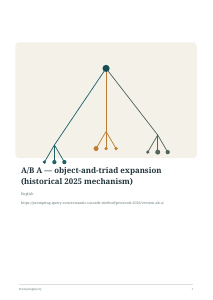
Start with a plain answer, analyze the entire prompt semantically and Socratically, write a flat list of N meaning objects, and form one contextual triad for each object: original concept, relevant opposite, and a third position beyond the pair. Search for the third by apophatic analysis, polar analysis, Socratic doubt, then dialectical synthesis, recording failures and contextual choices. Do not silently replace the old triad with the later tetrad. Apply each of 29 frame points to each of three elements. For each such cell write three factual and three counterfactual questions. The latter must name the altered condition. Every question keeps the whole prompt as context. A local answer consists of the question followed by five or six substantive sentences. Answer each question on its own terms, then categorize and synthesize without erasing the original answers. Compare the derived result with the pre-method baseline.
5. Question generation and volume
Q = N × 3 triad elements × 29 frame points × (3 factual + 3 counterfactual) = 522N. With 15 revised objects, Q = 7,830; the saved answer count is 564, not 7,830.
6. Exact local question register
The source does not preserve a separate fixed question list for this variant. Generate the questions by the rules above and save the resulting list before answering.
7. Answer instruction
For each question, present its exact wording, then answer at the length fixed in §5. Keep the entire applicable prompt and frozen preparation in view. Address the specific operation, mode and frame point. Give concrete criteria or explanatory mechanisms rather than filler. Do not use an answer to a sibling question as unstated evidence. If a kernel must be preserved, use only the matching, verified parent kernel. Historical answers that were copied remain labeled copied.
8. Preservation and derived results
For every question store: immutable question ID; full original prompt; full prepared or focused prompt; object; tetrad/triad position or axis; frame point; operation; factual/counterfactual mode; child variant if any; exact question; raw answer; model and settings if available; source and verification status. Store the entire question register before any answer. Keep the raw answers unchanged when preparing a readable synthesis. Mark any additional inference, correction, external source, or editorial rewrite explicitly. A question count is not an answer count.
Variant-specific deliverables: Question register, standalone answer register, baseline, categorized synthesis, idea ledger, internal/external checks, and a completion ledger.
Create the readable synthesis only after the raw corpus is frozen. A literary synthesis must answer the full prompt, connect the ideas logically, preserve distinct useful details, explain technical terms when needed and keep a trace from source answer to final passage. Record omissions, merges and new editorial inferences. It must not be treated as a replacement for raw answers.
9. Verification and stopping rule
Check arithmetic against the frozen object/frame register. Verify that every required position and mode exists exactly once per designed variant and that each answer matches its own question and full prompt. Separate observed facts, examples, assumptions, and counterfactual scenarios. Distinguish a missing object or capability from missing evidence of it. Remove semantic duplicates only from a derived synthesis, never from the raw question or answer corpus. Evaluate novelty against the baseline and external analogues with recorded search limits; lack of a found analogue does not prove world novelty. Report actual completion, omissions, and context-isolation limits.
Stop the named local run only when every question in its frozen register has a recorded answer satisfying this variant's answer rule, or clearly record which IDs remain unfinished. Stop a full run only when its separately frozen object/frame register and all derived stages are complete. Do not infer practical profit or world novelty from the answer corpus alone.
10. Historical cautions
The first A/B protocol assumed three influencers; the operator removed that unsupported number and any relation among influencers. The prompt shown above is the corrected comparison prompt. The old temporal frame includes a historical-development item twice; retain and flag that duplicate in historical reproduction.
11. Primary evidence and provenance
- 260927-GPT-original-algorithm-reconstruction-01.md (C:\CodexWork\repos\260926-cascade-semantic-method-2609\GPT\output\260927-GPT-original-algorithm-reconstruction-01.md) — SHA-256
b25938998b05018f6231cad6bba48b4cee09648ea1ffb1beffae9070f22965e4 - 260927-GPT-cascade-ab-study-protocol-02.md (C:\CodexWork\repos\260926-cascade-semantic-method-2609\GPT\output\260927-GPT-cascade-ab-study-protocol-02.md) — SHA-256
36d104ed35f62cabcb6a18e125384d8532bb353fe5afb4919c96ed2f49562c9c - 260927-GPT-cascade-a-revised-questions-01.json (C:\CodexWork\repos\260926-cascade-semantic-method-2609\GPT\output\260927-GPT-cascade-a-revised-questions-01.json) — SHA-256
6025ccaacddf5ed0e5dc71867120dd6a6f8a74a8ec3663cb3080be7528456f63 - 260927-GPT-cascade-ab-revised-progress-14.json (C:\CodexWork\repos\260926-cascade-semantic-method-2609\GPT\output\260927-GPT-cascade-ab-revised-progress-14.json) — SHA-256
a8631862a96a46fd58db5c21281195bf2381d70d9db8e468a57a201946c715e3
Appendix A — the complete historical 29-point frame
Все 29 пунктов прежней рамки
Время — 7
- В какое время возникает объект: прошлое, настоящее или будущее?
- Как объект развивался исторически?
- Какие события вызвали его появление?
- Какие последствия он создаёт?
- Как объект развивался исторически?
- Возможно ли продолжение его существования в будущем?
- На какой стадии своего цикла он находится: возникновение, рост, зрелость или упадок?
Пятый пункт повторяет второй в исходнике. В исторической реконструкции повтор сохранён.
Пространство — 7
- Где проявляется объект?
- Где он отсутствует и почему?
- Какие условия делают явление возможным или невозможным?
- Какие среды для него благоприятны или враждебны?
- Где его границы?
- Какие формы он принимает в разных регионах?
- В каких географических или культурных средах он преобладает?
Внешнее взаимодействие — 11
- Какие внешние, ограниченные объекты взаимодействуют с явлением?
- Существуют ли группы объектов?
- Является ли сам объект частью группы?
- Являются ли взаимодействующие с ним объекты частями групп?
- Есть ли внутри групп разделение, например иерархическое или функциональное?
- Какие роли существуют в группе?
- Какую роль играет объект в группе?
- Какие группы взаимодействуют с объектом?
- Кто заинтересован в его существовании?
- Какие нормы, идеологии и мифы с ним связаны?
- В каких культурах он преобладает или отвергается?
Причинность — 4
- Что вызвало появление объекта?
- К каким последствиям он приводит?
- Каковы его явные и неявные функции?
- Какие альтернативные причины возможны?
12. Minimal portable run command
Give another model this file plus the exact source prompt and chosen cell. Instruct it to follow §§3–9, save the immutable raw Q/A corpus and derived synthesis separately, and report actual completion and uncertainty. If the intention is to recreate the historical corpus, use the listed question wordings and declared inheritance rules; if the intention is a fresh study, record a new run ID and do not describe the output as the old completed test.
Appendix B — exact 15 triads of the revised A run
| Object | Thesis/original | Contextual opposite | Third position beyond the pair |
|---|---|---|---|
| 1 | Создание | Разрушение | Изменение условий существования |
| 2 | Ведение | Оставление без ведения | Организация поддержания |
| 3 | Монетизация | Отсутствие денежного дохода | Обмен ценностью |
| 4 | Искусственный персонаж | Документальный образ реального человека | Правила представления образа |
| 5 | Влияние | Отсутствие влияния | Изменение условий выбора |
| 6 | Социальная сеть | Изоляция участников | Организация доступа к взаимодействию |
| 7 | Отсутствие обмана | Обман | Проверка и исправление существенных представлений |
| 8 | Создатель | Потребитель готового результата | Участник преобразования |
| 9 | Аудитория | Публикующий субъект | Участник обмена содержанием |
| 10 | Плательщик | Получатель оплаты | Сторона исполнимого обмена |
| 11 | Контент | Отсутствие выраженного содержания | Условия появления смысла |
| 12 | Ценность | Бесполезность для выбранной цели | Соответствие результата цели и условиям |
| 13 | Затраты | Поступления | Преобразование ресурсов |
| 14 | Посредничество | Прямое взаимодействие | Организация обмена |
| 15 | Ответственность | Безответственность | Распределение исполнимых обязательств |
These fifteen triads were the fixed register for the planned 7,830 questions. They are contextual constructions, not universally correct antonym triples. The saved question register retains all 7,830 formulations; the record of actual responses remains 564. Each reproduction must identify whether it uses this fixed historical register or makes fresh triads from a new prompt.
Appendix C — stable question-ID and generation rule
For each object 01–15, each element E1–E3, each of 29 frame points, and each factual F1–F3 or counterfactual C1–C3 variant, make one question that explicitly relates that element and frame to the full prompt. Store an ID of the form A01-E1-T1-F1 and the exact changed condition for counterfactuals. The saved 7,830-question register is the authoritative historical wording; this generative rule is the portable method. Do not claim identical model outputs from a new execution.